1987 Bronco C6 Wiring Diagram Site Www.Ford-Trucks.Com
| Ford F-series (7th generation) | |
|---|---|
 1980 Ford F-100 Ranger | |
| Overview | |
| Manufacturer | Ford |
| Production | September 1979–1986[1] 1980-1986 (Mexico and Venezuela) 1982-1987 (Argentina: light-duty) 1982-1990 (Argentine republic: Ford medium duty) |
| Model years | 1980-1986 |
| Assembly | North America:
|
| Body and chassis | |
| Body manner | two-door pickup 2-door extended-cab pickup 4-door pickup |
| Powertrain | |
| Engine | Gasoline 221 CID (3.half-dozen 50) Falcon (F-100, Argentina) 232 CID (3.8 L) Essex V6 (1982-83 (Us), 1986 F-150, Mexico) 240 CID (4.1 L) I-6 (Australia) 255 CID (four.2 L) Windsor V8 292 CID (four.viii L) Fase II V8 (F-150, F-250, F-350 and F-600, Argentina) 300 CID (4.ix L) I6 302 CID (5.0 L) Windsor V8 335 CID (v.four L) Windsor V8 (F-600, Mexico) 351 CID (5.viii L) Windsor V8 351 CID (5.viii L) Cleveland V8 (1980-85, Australia) 400 CID (6.6 L) 335 V8 460 CID (7.5 50) 385 V8 Diesel fuel 203 CID (3.3 L) Perkins diesel l4 (F-100, Argentina) 305 CID (5.0 Fifty) Perkins diesel l6 (F-250, F-350, F-400 and F-600, Argentina) 354 CID (5.8 L) Perkins diesel l6 (F-600 and F-700/7000, Argentina) 373 CID (half-dozen.one L) Deutz diesel l6 (F-700/7000, Argentine republic) 420 CID (vi.9 L) International Harvester Diesel V8 |
| Transmission |
|
| Dimensions | |
| Wheelbase | Regular cab 8' box: 133 in (3,378 mm) Regular cab 6.75' box/Flareside: 117 in (2,972 mm) SuperCab viii' box: 155 in (three,937 mm) SuperCab 6.75' box: 138.viii in (iii,526 mm) Crew cab: 168.4 in (4,277 mm) |
| Length | Regular cab 8' box: 213.three in (5,418 mm) Regular cab 6.75' box: 197.i in (five,006 mm) SuperCab eight' box: 235.3 in (5,977 mm) SuperCab 6.75' box: 219.1 in (five,565 mm) Crew cab: 248.9 in (vi,322 mm) |
| Width | 79 in (2,007 mm) |
| Chronology | |
| Predecessor | Ford F-Serial sixth generation (1973–1979) |
| Successor | Ford F-Serial eighth generation (1987–1991) |
The seventh generation of the Ford F-Series is a range of trucks that was produced past Ford from the 1980 to 1986 model years. The first complete redesign of the F-Series since the 1965 model year, the seventh generation received a completely new chassis and body, distinguished past flatter body panels and a squarer grille. This generation marked several firsts for the model line, including the introduction of the Ford Bluish Oval grille emblem, the introduction of a diesel engine to the model line, and a dashboard with a full fix of instruments (optional). Conversely, this generation marked the end of the long-running F-100, the Ranger trim, and sealed-axle headlamps. This was also be the final generation of the F-Series produced with the traditional Flareside bed, using split up rear fenders and taillamps, steel sides, and an (optional) wooden floor.
Serving as the basis for the eighth and 9th-generation F-Series, the 1980 F-Series architecture lasted through the 1998 model year, also underpinning the Ford Bronco from 1980 to 1996. Though sharing nigh no body parts, the model line again shared mechanical commonality with the Ford Eastward-Series.
Through its product, this generation of the F-Series was produced by Ford by multiple sites in North America and by Ford Argentina and Ford Australia.
Background [edit]
Halfway through its model cycle, the sixth-generation Ford F-Serial became the best-selling truck in the The states in 1977. During the development of the seventh-generation F-Series, the 1979 oil crisis led to increased attention towards fuel economy; in addition, calorie-free trucks (including most models of the F-Series) saw the introduction of federal fuel economy standards (Cafe).
In contrast to Ford full-size machine lines (such as the Ford LTD), downsizing could not exist considered as a practical design option. Though minor adjustments in size could be made to the model line, preserving payload adequacy was a key consideration, along with retaining and upgrading blueprint features that consumers had plant popular in the previous generation.
Forth with increasing capability and fuel economy, a central role of the evolution was to improve corrosion protection. While the previous generation phased in plastic fender liners in 1977, Ford farther researched corrosion reduction, designing the cab and bed to reduce the amount of trapped road grime.[2]
Pattern history [edit]
1980-1981 [edit]

For 1980, the 7th-generation F-Serial was introduced, offer the standard cab and the SuperCab extended cab.[3] Equally office of several functional upgrades, the vehicle received a column-mount ignition switch and an interior-mountain hood release.[4] While the 4-door crew cab was dropped from the line, two new versions of the F-350 were introduced, including a "Vi-wheeler" dual-rear wheel option and the first F-350 4x4.[5] [six] [vii]
For 1981, the exterior and interior were finer carryover, with Ford focusing revisions to the powertrain. Subsequently standardizing them on two-wheel drive trucks the year before, Ford made radial-ply tires on all F-Series pickups.[4] [viii] In another change, halogen headlamps were introduced equally a standard characteristic.[4] [eight]
1982-1983 [edit]

For the 1982 model yr, the F-Series underwent a minor facelift to the front fascia. Along with a simpler grille pattern, the update replaced the "FORD" hood lettering with the Ford Blue Oval emblem centered in the grille; with the exception of Ford Raptor vehicles, this design remains in use on currently-produced F-Serial vehicles.[9] In some other change, fender badging was redesigned, switching accent from trim to model series (with larger F-100/F-150/F-250/F-350 badges). To accommodate for the introduction of the Ford Ranger compact pickup truck, the Ranger trim was dropped and multiple revisions were made to the trim line. In another change, the complimentary-continuing Camper Special pick package was discontinued, functionally combined with the Trailer Towing package.[9] As an additional model, Ford introduced the F-250HD, finer a hybrid of the F-250 and F-350.[nine]
For 1983, Ford returned the iv-door coiffure cab to the model line (last seen since 1979), offering it merely for the unmarried rear-cycle F-350.[ten] The options and trim lines underwent farther revision, as the Free-Wheeling choice package became a free-continuing XLS trim level (nonetheless intended as the sportiest version of the F-Series).[10] Equally the model line was largely overshadowed by both the F-150 and the smaller Ranger (with some versions near matching it in payload capability), 1983 was the last year for the long-running F-100 pickup truck.[x]
1984-1986 [edit]

1985-1986 F-350 crew cab DRW
For 1984, the F-150 became the smallest version of the model line, following the retirement of the F-100. As a condom change, a clutch interlock prevented engine starts without depressing the clutch pedal.[11] To further gainsay corrosion, Ford increased the use of galvanized and pre-treated steel body panels.[iv]
For 1985, the interior underwent a small-scale revision. While the dashboard design remained the same, the optional woodgrain trim was updated for a more modern appearance; in a like style, the seat trim was updated.[12] The F-350 model line was expanded, every bit the crew cab became bachelor with dual rear wheels.[12] Every bit an choice on college-trim vehicles, Ford introduced a brushed-aluminum overlay trim panel for the rear tailgate, mounted affluent betwixt the taillamps.[12]
For 1986, the F-Series saw few substantial changes. To streamline production, all vehicles received a total set up of instruments (with just the tachometer remaining optional).[xiii] Two-tone paint options were revised, as Ford deleted options that painted the roof and/or cab with the accent color. To simplify ordering and product, Preferred Equipment Packages were paired directly with trim levels, reducing the number of distinct options; traditional stand up-lonely option packages remained in place.[12]
Design overview [edit]
Chassis [edit]
The first ground-up alter to the F-series platform since 1965, the 1980 F-Series chassis used an all-new design, though returning to trunk-on-frame structure.[14] [15] Once more using 8-inch frame rails for the ladder frame,[15] the new chassis adopted nearly identical wheelbases from the 1973-1979 generation.[16]
Powertrain details [edit]
During its production, the 7th generation would run across multiple revisions to the powertrain line, also marking several firsts for the F-Series. For 1980, the powertrain line was nearly carryover for 1979. The standard engine was a 4.9L I6 (the 300 Truck Vi), with an optional 4.9L V8 (the 302 V8, branded as 5.0L), 5.8L V8 (351M), and 6.6L V8 (400); the 7.5L V8 was dropped from the F-Serial entirely.[xvi] Several dissimilar transmissions were offered for the wide variety of engines used past the model line. On two-wheel drive trucks, a cavalcade-shifted three-speed manual was standard, with a four-speed manual offered as an selection (the latter was standard on 4x4 trucks). In 1980, a 3 speed "Select-Shift" C6 automatic was the sole automatic transmission offering.[17] [18]
For 1981, Ford introduced a 4.2L V8 (a smaller-displacement 4.9L) equally an option (exclusive to the F-100 4x2); the 115-hp engine was the smallest-displacement V8 offered on a modern American pickup truck.[nineteen] A four-speed manual overdrive transmission and a four-speed automatic with overdrive became offered as options.[nineteen]
For 1982, a 110hp 3.8L V6 was introduced equally the standard engine for the F-100 (the 4.9L six remained available on the F-150 and F-250), becoming the first V6 engine offered in the F-Series (and the smallest-displacement engine offered since 1953).[xx]
For 1983, several changes were fabricated to the engine line. The 4.2L V8 was discontinued, making the iii.8L V6 the sole engine for the F-100.[21] As the 5.8L (351M) and six.6L V8s ended product altogether, Ford introduced a different 5.8L (351W) to model line, serving as the commencement F-Series engine with computerized engine controls.[21] Replacing the half-dozen.6L engine, the 7.5L V8 made its return in the F-250HD and F-350 (becoming offered for 4x4s for the first time); the first Ford diesel-fuel engine was also introduced (the International 6.9L IDI V8).[21]
For 1984, the three.8L V6 was dropped from the F-Serial (as the F-100 had been discontinued), with the 4.9L now over again serving as the standard engine. Every bit an additional option, an "HO" version of the 5.8L V8 was introduced; a 4-bbl carburetor increased output from 150 to 210hp.[22] [18]
For 1985, Ford revised several engines of the F-Series (though the powertrain lineup remained unchanged).[23] After its introduction to the five.8L V8 for 1983, the 4.9L V8 and four.9L I6 both received EEC-Iv estimator controls; the 4.9L V8 became the starting time Ford calorie-free truck engine to receive fuel injection (adding 52hp to its output).[23]
For 1986, the engine line returned with no changes.[24] The cavalcade-shifted manual transmission was in its last year; the second-to-last American vehicle with the blueprint (catastrophe in 1987 with Chevrolet/GMC R-Series pickup trucks).
| Ford F-Serial engines (1980-1986) | ||||||
|---|---|---|---|---|---|---|
| Engine | Configuration | Fuel delivery | Production | Output | Notes | |
| Power | Torque | |||||
| Ford Essex V6 | 3.8 L (232 cu in) V6 | 2bbl | 1982–83 (1986 in Mexico) | 110 hp (82 kW) | 183 lb⋅ft (248 North⋅chiliad) | Standard on F-100 models not available in California |
| Ford Truck Six (250) | 4.1 Fifty (250 cu in) I6 | 1bbl (1980–82) 2bbl (1982–85) | 1980–85 | 131 hp (98 kW) | 225 lb⋅ft (305 Due north⋅yard) | Australian market but |
| Ford Small Cake V8 | 4.two L (255 cu in) V8 | 2bbl | 1980–81 | 115 hp (86 kW) | 206 lb⋅ft (279 N⋅yard) | |
| Ford Truck Six (300) | 4.9 L (300 cu in) I6 | 1bbl | 1980 | 117 hp (87 kW) | 227 lb⋅ft (308 N⋅one thousand) | |
| 1bbl | 1980 | 120 hp (89 kW) | 229 lb⋅ft (310 N⋅yard) | Just bachelor F-250 HD and F-350 | ||
| 1bbl EFI | 1981–86 | 125 hp (93 kW) | 250 lb⋅ft (339 N⋅m) | |||
| Ford Small Block V8 | 4.9 L (302 cu in) V8 | 2bbl | 1980–85 | 133 hp (99 kW) | 233 lb⋅ft (316 N⋅chiliad) | |
| EFI | 1985–86 | 190 hp (142 kW) | 285 lb⋅ft (386 N⋅yard) | |||
| Ford 351M V8 | 5.8 L (351 cu in) V8 | 2bbl | 1980–82 | 136 hp (101 kW) | 262 lb⋅ft (355 North⋅m) | |
| Ford Small-scale Block V8 | 2bbl | 1980–82 | 136 hp (101 kW) | 262 lb⋅ft (355 Due north⋅thou) | ||
| Ford Cleveland V8 | 2bbl | 1980–85 | Australian market only | |||
| Ford Small Cake V8 | 2bbl EFI | 1983–85 | 150 hp (112 kW) | 280 lb⋅ft (380 N⋅thou) | ||
| Ford Small Block HO V8 | 4bbl EFI | 1984–86 | 210 hp (157 kW) | 305 lb⋅ft (414 Due north⋅yard) | 1984–85 only available on special-ordered F-150 models (5.i.due north. designation H), as well every bit HD F-250 and F-350 models 1986 available all models | |
| Ford 400 V8 | vi.6 L (400 cu in) V8 | 2bbl | 1980–82 | 153 hp (114 kW) | 309 lb⋅ft (419 N⋅m) | Only available F-250 HD and F-350 |
| International Harvester IDI V8 (diesel fuel) | half-dozen.ix L (420 cu in) V8 | IDI (diesel) | 1983–86 | 150 hp (112 kW) | 285 lb⋅ft (386 Northward⋅thousand) | |
| IDI (diesel) | 1983–86 | 170 hp (127 kW) | 315 lb⋅ft (427 N⋅1000) | |||
| Ford 385 V8 | seven.five L (460 cu in) V8 | 4bbl EFI | 1983–86 | 245 hp (183 kW) | 380 lb⋅ft (515 North⋅m) | |
Break components [edit]

1986 Ford F-250 XLT Lariat SuperCab 4x4
On 2-wheel drive vehicles, the Twin I-Beam contained front suspension made its return; on 4x4-drive vehicles, the live front axle was replaced past a "Twin Traction Beam" design.[25] [26] The first standard-equipment independent front suspension system used in a four-wheel drive pickup truck, Twin Traction Beam (TTB) is a variant of the Twin I-Axle pattern, with one of the curl-sprung front I-axle axles supporting the front differential.[27]
The F-150 used a light duty Dana 44 TTB. From 1980-1984, the rear beam was typically a Ford 9-inch axle, with the Ford 8.8 axle beingness phased in gradually; the ix-inch ended product (aslope this generation) in 1986.
The F-250 used an 8 lug version of the Dana 44 TTB called the Dana 44 TTBHD with the Dana 50 TTB being an pick. The rear beam was a Dana sixty until mid-1985 when Ford phased out that axle for their own Sterling ten.25. Dana 60s could be either full float or semi bladder and came with a range of gear ratios. Semi-float Dana 60s were either c-clip style, which utilize c-clips to hold the axle shafts in, or pressed-in bearings which held the axles in with a special bike bearing that bolted to the outer beam housing inside the brake drum. These were typically used in lighter-duty trucks. Up until so, early 1985 models were built with left over 1984 materials, making some parts tough to find.
The F-350 used the Dana fifty TTB in front end until a mid-year change in 1985, when the F-350 was fitted with the Dana threescore solid forepart beam. F-250s could exist ordered with a Dana l TTB if it was a heavier duty model; all other F-250s were equipped with a Dana 44 TTB. These trucks were leaf sprung and used a single gas shock with no scroll springs and radius artillery like on the F-150. For the rear beam the F-350 trucks used a Dana 60 for the unmarried rear wheel trucks and a Dana 70 for the dual rear wheel trucks until 1985 when Ford again phased in their own Sterling beam.
Factory lifts used 2" blocks on the rear interruption, or two" forepart and 4" rear on HD trucks, usually on F250s and higher trims. Heavier duty F150s could be ordered with 2" blocks.
Four-cycle drive system [edit]
With the exception of the F-100, four-wheel drive was offered for all versions of the 7th-generation F-Series during its product (marking the introduction of the F-350 4x4). Along with transmission front hubs, the F-Series as well offered automatically-locking front hubs.[28] Through its unabridged production, the model line used either the New Procedure Gear NP208F or transfer cases sourced from Borg-Warner. Using a manual two-speed blueprint, the F-Serial 4x4 used a stick-shift 4WD engagement (4 Low, 4 High, Neutral and 2 High).
Body design [edit]
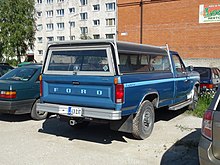
Ford F Series 1980-1986 Rear View

1980-1981 F-250 Custom camper
The 7th-generation F-Series carried over all three cab styles from previous generation, including two-door cab, two-door extended cab (Super Cab), and four-door coiffure cab configurations. Four bed configurations were offered, including a fendered half-dozen+ 3⁄iv -pes Flareside bed, 6+ 3⁄four -foot and eight-foot Styleside beds, and an 8-foot "Six-wheeler" Styleside bed for F-350 dual-rear wheel trucks.[29] The 8-foot Flareside bed was discontinued, along with the use of wooden floorboards; all F-Series trucks were now produced with a steel bed floor. While the Flareside bed saw niggling change to its overall dimensions, the interior of the Styleside bed was widened v inches (in comparison to 1979).[30] [31]
To amend the aerodynamics of the exterior, the long-running clamshell hood design feature was retired, as Ford faired the hood into the fenders. Adopting several pattern elements from the 1979 update of the Ford Econoline (though using a longer, lower front end fascia), the forepart grille became flatter and more rectangular. Though lower in overall height, the cab was designed with larger windows and a more steeply angled windshield (creating larger vent windows). Bordered past wraparound taillamps, the tailgate of Styleside trucks adopted a tailgate using expanded key space for "Ford" lettering.
Interior design [edit]
Carrying over only the 2-spoke steering wheel from the previous generation, the 7th-generation F-Serial underwent multiple upgrades to the interior as role of the redesign. Coinciding with the more than steeply sloped windshield, the dashboard was larger and covered by a pad (on all trim levels). The visibility of bare sheetmetal was reduced, as all models received color-keyed trim for the A-pillars and larger door panels (covering nearly the entire door). On higher-trim models, the dashboard received a full ready of instruments (including a tachometer for the first time).[32] Entry-level trims were fitted with blackness dashboard trim, with higher-trim vehicles using several styles of false wood trim (used simply for the dashboard).[33] After 1980, Ford discontinued the factory-installed CB radio option, withdrawing the viii-track cassette histrion afterward 1982.[32] [34]
The SuperCab extended cab was offered in two rear seating configurations, including two side-mounted jump seats or a three-passenger bench seat.[35]
Trim [edit]
1980-1981 [edit]
For 1980 and 1981, the F-Serial carried over the same trim nomenclature from the 1973-1979 F-Series. The Custom served as the base of operations trim, with the Ranger and Ranger XLT every bit mid-level trims, and the Ranger Lariat equally the highest-level trim. All vehicles except the Custom were fitted with a wood-trim nuance. The trim level was designated on the dashboard above the radio, with the Ranger XLT and Ranger Lariat receiving XLT and Lariat exterior badges.
The Camper Special and "Free-Wheelin" option packages made their return to the model line. Though no longer using a distinct wheelbase, the Camper Special retained its heavy-duty and functional option features and was offered in combination with Trailer Towing package and Six-Wheeler pickup truck.[36] Though again marketed as the sportiest F-Series, the "Free-Wheelin" pick package underwent a major revision in its appearance, trading its multicolor exterior stripes for subdued pinstripes (or optional ii-tone paint); its coma grille remained a distinguishing characteristic.[25] [35]
1982-1986 [edit]
For 1982, the trim levels underwent a revision. The Ranger name was moved from F-Serial to the 1983 compact pickup (introduced early on 1982), with Ford also dropping the long-running Custom proper name. The Standard trim replaced the Custom, with the Ranger trim replaced past the Forty below the newly renamed XLT Lariat. Replacing the "Free-Wheelin" package, the XLS trim was the sporty counterpart of the luxury-oriented XLT Lariat; the exterior received blacked-out trim, model-specific striping, and aluminum-style dashboard trim.[37]
For 1984, the trim level underwent further changes, as the XLS trim was dropped, and the XLT Lariat was renamed XLT.[38] For 1985, the alter was reversed, with the Lariat again combined with the XLT.[39]
Variants [edit]
Medium-duty F-Series [edit]
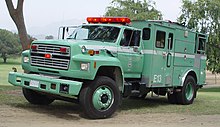
For 1980, the medium-duty F-Series trucks (F-600 through F-800) underwent their first redesign since 1967. Adopting design elements from the heavier Class seven-8 Ford L-series, the medium-duty (Course half dozen-7) trucks received a trapezoidal front end grille; in a major design change, separate forepart fenders fabricated their return (for the start fourth dimension since 1957). Sharing its cab with the pickup trucks, medium-duty F-series trucks were offered as a 2-door standard cab and equally a four-door coiffure cab. While the previous rear-hinged hood remained standard, the forward-tilting hood became offered for the starting time fourth dimension, chop-chop overtaking it in production.
At its 1980 launch, the medium-duty trucks were offered with ii gasoline engines, a 6.1L (370) and a seven.0L (429) V8; both engines were variants of the 7.5L V8 developed for truck employ. Initially launched with the Caterpillar 3208 and Detroit Diesel 8.2L V8 engines as options, multiple diesel fuel engines were offered through its production. During the belatedly 1980s, the V8 diesels were replaced by inline-6 diesels jointly developed past Ford and New Kingdom of the netherlands, with the model line ultimately receiving Cummins B-series and C-series diesel fuel inline-6 engines.
With the exception of powertrain revisions, this generation of the medium-duty F-Serial was produced virtually unchanged through its 19-yr model run. For 1984, the grille was revised, replacing the "FORD" lettering with the Ford Blueish Oval emblem (among the terminal Ford vehicles receiving the change). For 1995, the tilting hood was restyled with a new grille and plough signals (the interior of the cab remained nearly unchanged from 1980).
After the 1998 model twelvemonth, this generation was replaced by an all-new medium-duty model range, Post-obit the 1997 auction of the Ford heavy-duty truck line to Freightliner, the 2000 F-650/F-750 Super Duty became the largest vehicles sold by Ford.
Ford Bronco [edit]

1986 Ford Bronco Eddie Bauer
For 1980, the 3rd-generation Ford Bronco was introduced, becoming the second version based on the F-Series model line. As the F-100 concluded its use of iv-bike drive, the Bronco became derived from the higher-payload F-150, over again shortened to a 104-inch wheelbase. Competing against the Chevrolet K5 Blazer and the Dodge RamCharger, the Bronco was again bodied as a two-door carriage with a lift-off rear hardtop. Offered with function-fourth dimension four-wheel drive, the Bronco shared its powertrains with the F-150 4x4, including the iv.9L I6, 4.9L (5.0L) V8, and 5.8L V8, pairing the engines with transmission and automated transmissions.
In 1985, Ford introduced an outdoors-themed Eddie Bauer trim package for the Bronco, later introducing across multiple Ford light truck lines.
Foreign production [edit]

1982–1983 Ford F-100 utility (Australia-market RHD model)
Argentine republic [edit]
Ford Motor Argentina launched domestic production of the F-Serial in 1982 in General Pacheco. Replacing imported trucks from the The states, Ford Argentina marketed the F-100 pickup truck, F-350 chassis cab, and the medium-duty F-600 and F-700 (later F-7000).[40] [41] [42] [43]
Produced from 1982 to 1987, the F-100 shared its sheetmetal with its Northward American counterpart, differing primarily in its powertrain. The standard engine was a 221 cubic-inch I6, a 292 cubic-inch V8, and naturally-aspirated and turbocharged 3.3L Perkins diesel I4 engines; the F-350 had the 292 V8 as standard and an optional 5.0L Perkins I6 diesel.[40] [41]
The medium-duty F-600 and F-700 (later F-7000) produced by Ford Argentina as well differed in its powertrain design. The F-600 used a 292 V8 as a standard engine with an optional 5.0L Perkins I6 diesel.[42] The F-700 used diesel engines exclusively, offering a standard 5.0L Perkins I6 with an optional 5.8L Perkins I6 and 6.1L Deutz I6.[42] [43] Ford Argentina ended production of this generation of medium-duty trucks in 1990.
Dealers such as Igarreta nonetheless provide customized configurations for the trucks, such as extended cabs and other bodywork.[ citation needed ] Additionally, the Deutz 913-serial engines (four, five and 6 cylinder) for aftermarket were offered from 1983 to 1987 for all models, including medium duty trucks.
Australia [edit]
Ford Commonwealth of australia introduced the sixth-generation F-Series for 1980, becoming the second generation of the F-Serial produced in Australia.[44] The model line shared its powertrains from the Ford Falcon; a four.1L I6 was standard, offer a 5.8L V8.[44] Adult for correct-manus drive, Australian-produced F-Series trucks sourced their dashboards from Ford Canada.[45]
Come across also [edit]
- Ford F-Serial (8th generation)
- Ford F-Series (ninth generation)
References [edit]
- ^ "The Leader-Post - Google News Annal Search".
- ^ Wickell, Dale Wickell Dale Wickell is an automotive proficient who has worked in the industry for more than four decades He currently works for LeMay-America'due south Car Museum our editorial process Dale. "The History of the Ford F-serial Pickup Truck 1980-1986". LiveAbout . Retrieved 2021-11-25 .
- ^ "1980 Ford Pickup Brochure". oldcarbrochures.com . Retrieved 2021-eleven-25 .
- ^ a b c d Wickell, Dale Wickell Dale Wickell is an automotive expert who has worked in the industry for more than four decades He currently works for LeMay-America'due south Car Museum our editorial process Dale. "The History of the Ford F-series Pickup Truck 1980-1986". LiveAbout . Retrieved 2021-11-25 .
- ^ "1980 Ford F-150 F-250 Pickups". BlueOvalTech.com . Retrieved 2021-eleven-25 .
- ^ "1980 Ford Pickup Brochure". oldcarbrochures.com . Retrieved 2021-11-27 .
- ^ "1980 Ford Pickup Brochure". oldcarbrochures.com . Retrieved 2021-11-27 .
- ^ a b "1981 Ford F100 F150 F250 Specs". BlueOvalTech.com . Retrieved 2021-11-25 .
- ^ a b c "1982 Ford F150 Specs". BlueOvalTech.com . Retrieved 2021-11-25 .
- ^ a b c "1983 Ford F150 Pickup". BlueOvalTech.com . Retrieved 2021-11-25 .
- ^ "1984 Ford F-150 F-250 Trucks". BlueOvalTech.com . Retrieved 2021-xi-25 .
- ^ a b c d "1985 Ford F-Series F150 Specs". BlueOvalTech.com . Retrieved 2021-11-25 .
- ^ "1986 Ford F150". BlueOvalTech.com . Retrieved 2021-11-25 .
- ^ "Directory Alphabetize: FMC Trucks-Vans/1981_Trucks-Vans/1981_Ford_Pickup_Brochure". world wide web.oldcarbrochures.com . Retrieved 2021-11-25 .
- ^ a b "1982 Ford Pickup Brochure". world wide web.oldcarbrochures.com . Retrieved 2021-11-25 .
- ^ a b "1980 Ford F-150 F-250 Pickups". BlueOvalTech.com . Retrieved 2021-11-25 .
- ^ "1980 Ford Pickup Brochure". oldcarbrochures.com . Retrieved 2021-xi-25 .
- ^ a b "1984 Ford F-150 F-250 Trucks". BlueOvalTech.com . Retrieved 2021-11-25 .
- ^ a b "1981 Ford F100 F150 F250 Specs". BlueOvalTech.com . Retrieved 2021-11-25 .
- ^ "1982 Ford F150 Specs". BlueOvalTech.com . Retrieved 2021-eleven-25 .
- ^ a b c "1983 Ford F150 Pickup". BlueOvalTech.com . Retrieved 2021-11-25 .
- ^ Wickell, Dale Wickell Dale Wickell is an automotive skilful who has worked in the industry for more than than four decades He currently works for LeMay-America'due south Car Museum our editorial process Dale. "The History of the Ford F-series Pickup Truck 1980-1986". LiveAbout . Retrieved 2021-11-25 .
- ^ a b "1985 Ford F-Serial F150 Specs". BlueOvalTech.com . Retrieved 2021-11-25 .
- ^ "1986 Ford F150". BlueOvalTech.com . Retrieved 2021-11-25 .
- ^ a b "1980 Ford F-150 F-250 Pickups". BlueOvalTech.com . Retrieved 2021-11-25 .
- ^ "1980 Ford Pickup Brochure". oldcarbrochures.com . Retrieved 2021-xi-25 .
- ^ "1980 Ford 4WD Pickup Brochure". world wide web.oldcarbrochures.com . Retrieved 2021-11-25 .
- ^ "Directory Alphabetize: FMC Trucks-Vans/1981_Trucks-Vans/1981 Ford iv-Wheeler Brochure". www.oldcarbrochures.com . Retrieved 2021-11-27 .
- ^ "1980 Ford Pickup Brochure". oldcarbrochures.com . Retrieved 2021-11-27 .
- ^ "1982 Ford Pickup Brochure". world wide web.oldcarbrochures.com . Retrieved 2021-11-25 .
- ^ "Directory Index: FMC Trucks-Vans/1979_Trucks-Vans/1979_Ford_Pickups". www.oldcarbrochures.com . Retrieved 2021-11-25 .
- ^ a b "1980 Ford Pickup Brochure". oldcarbrochures.com . Retrieved 2021-11-27 .
- ^ "1982 Ford Pickup Brochure". www.oldcarbrochures.com . Retrieved 2021-xi-27 .
- ^ "1983 Ford F150 Pickup". BlueOvalTech.com . Retrieved 2021-11-25 .
- ^ a b "1980 Ford Pickup Brochure". oldcarbrochures.com . Retrieved 2021-11-27 .
- ^ "1980 Ford Pickup Brochure". oldcarbrochures.com . Retrieved 2021-11-27 .
- ^ "1982 Ford Pickup Brochure". world wide web.oldcarbrochures.com . Retrieved 2021-11-27 .
- ^ "1984 Ford F-150 F-250 Trucks". BlueOvalTech.com . Retrieved 2021-11-25 .
- ^ "1985 Ford F-Series F150 Specs". BlueOvalTech.com . Retrieved 2021-11-25 .
- ^ a b "Coche Argentino - Ford_F100".
- ^ a b "Camión Argentino: Ford F-350 (1982-1987)". 22 May 2013.
- ^ a b c "Camión Argentino: Ford F-600 (1983-1990)". 12 August 2014.
- ^ a b "Camión Argentino: Ford F-700/F-7000 (1982-1992)". xviii July 2012.
- ^ a b "Car Part | Ford F-Series". carpart.com.au . Retrieved 2021-eleven-27 .
- ^ "Used Machine Communication: Ford F-series (1985-92)". world wide web.carsales.com.au . Retrieved 2021-11-27 .
1987 Bronco C6 Wiring Diagram Site Www.Ford-Trucks.Com
Source: https://en.wikipedia.org/wiki/Ford_F-Series_%28seventh_generation%29

Posting Komentar untuk "1987 Bronco C6 Wiring Diagram Site Www.Ford-Trucks.Com"